
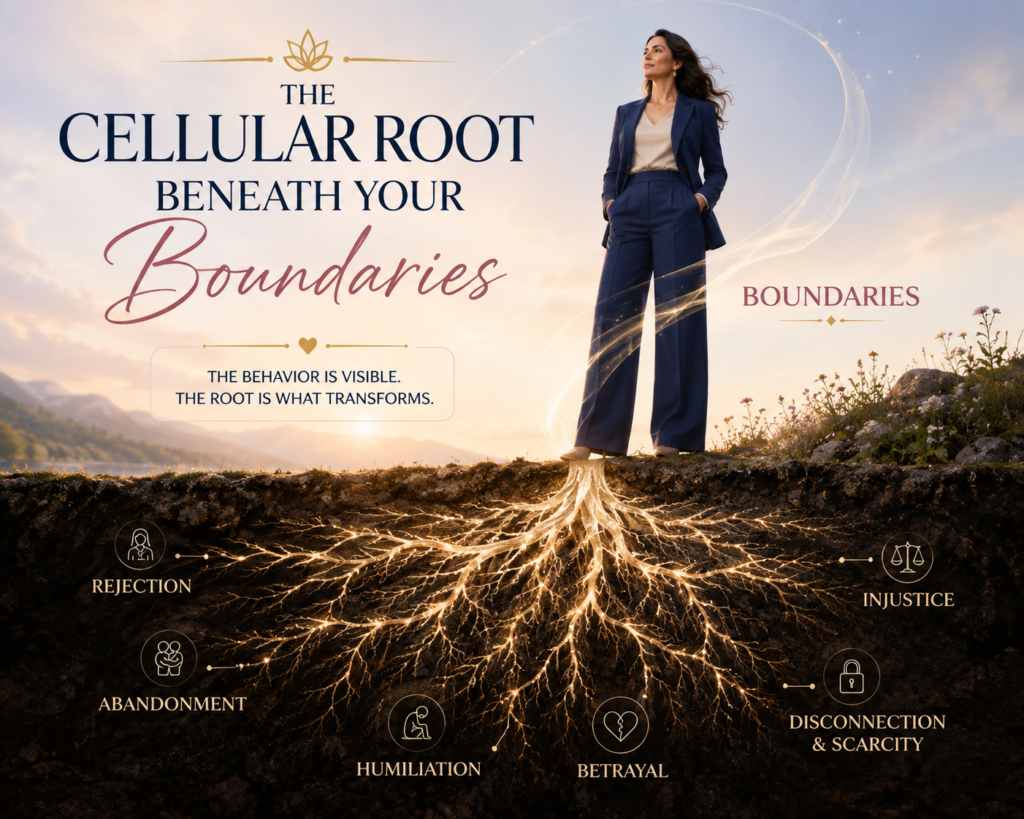
You know you need to say no.
You have read about boundaries. You understand assertive communication. You may have practiced the scripts:
“I don't have capacity for that.” “That doesn't work for me.” “I need to think about it.”
And yet, when the moment comes, YES comes out of your mouth.
Then you walk away frustrated with yourself.
Why?
Perhaps the problem is not that you don't know how to set a boundary.
Perhaps you haven't discovered what makes the boundary feel so difficult in the first place.
This is where my work through The Biocellular Recode™ goes deeper.
The Boundary Is The Behavior. What Is Underneath It?
Traditional boundary work can give us extremely useful tools. Assertiveness, communication skills, self-awareness, emotional regulation and learning how to say no all have value.
But I ask another question:
What is happening underneath the behavior that makes saying NO feel unsafe?
Because two women can know exactly the same boundary-setting technique.
One says no and continues with her day.
The other says no and immediately feels guilt, fear, anxiety or an overwhelming need to explain herself.
The words aren't the problem.
Something underneath the words is different.
This is where I begin looking for what I call the cellular root of the pattern through The Biocellular Recode™.
Your Boundary Problem May Have A Different Root Than Someone Else's
This is important.
Two people can display the exact same behavior and have completely different roots underneath it.
Both may overgive. Both may struggle to say no. Both may allow people to take more of their time than they want to give.
But I don't assume their roots are the same.
Depending on the person's history and the patterns we uncover, I may explore whether the difficulty is connected to an inner child wound, an ancestral pattern or a transgenerational fear.
For example:
Rejection Saying no may activate a fear of being disliked, criticized, excluded or rejected. The internal message may sound like: If I disappoint them, they may not want me anymore.
Abandonment The boundary may activate fear of losing love, connection, support or protection. Or it can appear in another direction: you become responsible for protecting everybody else because you know what it feels like not to feel protected.
Betrayal For some people, boundaries become complicated by experiences involving broken trust, control or the expectation that relationships are unsafe.
Injustice Someone who learned to suppress their own needs, particularly in relationships where their needs were dismissed or manipulated, may find it difficult to trust their right to say no.
Humiliation A boundary may bring up fear of criticism, shame, ridicule or being perceived as selfish, difficult or “bad.”
Disconnection & Scarcity The person may struggle to believe that their needs, time or desires are worthy of taking up space. The internal question becomes: Who am I to say no?
These are possible patterns to explore, not automatic diagnoses based on a behavior. The same “yes” can have a very different story underneath it.
And that is precisely why I don't believe the work should stop at the boundary itself.
Sometimes There Is A Mask Between The Wound And The Behavior
This is another important part of my work.
We develop ways of protecting ourselves from emotional pain.
I call some of these protective adaptations masks.
A woman may believe: “I'm just a very giving person.”
Maybe.
But what happens when giving becomes something she cannot stop doing without feeling afraid or guilty?
The mask may be worth exploring.
A Rescuer may continually solve other people's problems because not rescuing brings up painful feelings she doesn't want to experience.
An Overachiever may say yes to more work because being useful, productive or exceptional has become connected to feeling valuable.
A People Pleaser may abandon her own needs because disappointing someone feels more threatening than disappointing herself.
An Overprotector may continually step in because allowing another person to struggle activates something painful within her.
The mask is not the enemy.
It may have developed as protection.
But a protection that once helped us can eventually become a pattern that limits our relationships, our time, our authenticity and even our businesses.
This Is Why Knowing Better Doesn't Always Mean Doing Differently
This is the part that fascinates me.
You can intellectually understand your pattern. You can know where it came from. You can know what a healthy boundary sounds like. And still repeat it.
That's why, within The Biocellular Recode™, I don't want to work only with what the mind understands.
I want to explore what happens when the actual activation occurs.
What are you afraid will happen if you say no? What emotion are you trying not to feel? What does your body experience? What protective mask appears? What does that mask help you avoid?
The goal isn't simply to become better at saying NO. It is to understand why YES became your protection.
That is a very different conversation.
Watch Me Work With This Pattern In A Real Client Exercise
In the video below, I share an excerpt from a real client session inside The Soul Print Business Road Map™.
This is not the entire session. I intentionally selected the portion where I guide my client through an exercise around her difficulty setting boundaries.
Instead of simply giving her another script for saying no, I ask:
“What is stopping me from setting this boundary?”
We explore a possible abandonment wound, the protective mask she has been wearing and, most importantly, the emotional pain underneath the mask.
I then guide her away from immediately trying to solve the situation intellectually and toward noticing and allowing what is happening internally before returning to logic.
And something beautiful happens.
She explains the breakthrough herself.
She recognizes that as she becomes more aware of what is happening within her, she can feel less dependent on those masks and more able to show up as her authentic self.
https://www.youtube.com/watch?v=bgSaywEgZTA
Boundaries Are Also A Business Issue
Difficulty setting boundaries doesn't stay in your personal life.
It can enter your business as:
- Overdelivering after the scope of work has ended.
- Answering clients when you intended to rest.
- Reducing your price because someone hesitates.
- Accepting clients who aren't aligned.
- Giving away expertise you intended to charge for.
- Saying yes to opportunities that consume time but don't support your direction.
- Avoiding difficult conversations.
- Continually rescuing clients instead of allowing them to take responsibility.
And this is why I pay attention to patterns like boundaries when I work with revenue.
Sometimes what looks like a time-management, pricing or client-management problem is pointing toward something deeper that deserves exploration.
Your Business May Be Showing You The Root
If you recognize yourself in this, don't only ask: “How do I become better at setting boundaries?”
Try asking:
“What happens inside me when I try?”
That question can lead somewhere very different.
Through my Revenue Root Diagnosis & Report™, we explore the patterns underneath recurring business and revenue challenges and whether inner child wounds, ancestral imprints or transgenerational patterns may be influencing the way you receive, charge, show up, lead and grow.
Because sometimes your business problem is the place where a much deeper pattern has finally become visible.
Discover The Revenue Root Diagnosis & Report™
https://authentictransformation.ca/the-worth-revenue-recode/
The Biocellular Recode™ | Silvia Gálvez | Authentic Transformation